Last updated: August 24, 2026
A 5am routine is one of the most powerful productivity tools available to anyone willing to protect the early morning hours before the demands of the day begin. This guide covers exactly how to build one that sticks, what to include in each time block, and why the structure matters as much as the wake-up time itself.

Why a 5am Routine Changes Everything
A 5am routine works because the early morning hours between 5 and 7 AM are consistently the quietest, most interruption-free window in most people’s day. There are no emails coming in, no one asking for anything, and no competing priorities pulling at attention.
The science behind early morning productivity is well documented. Research from the University of Toronto published in the Journal of Applied Social Psychology found that morning people report higher levels of positive affect, greater feelings of health, and higher life satisfaction than those who sleep later, independent of total sleep duration.
A 5am routine also builds what behavioral psychologists call a “keystone habit,” a single discipline that creates momentum and makes other positive habits easier to maintain. Waking at 5 AM consistently is a signal to the nervous system that the day belongs to you before it belongs to anyone else.

The Compounding Effect of Early Mornings
Two hours of focused, uninterrupted work before 7 AM consistently outperforms five fragmented hours during a busy afternoon. The prefrontal cortex, which governs focus, decision-making, and creative thinking, operates at peak capacity in the first few hours after waking for most people.
Authors like Hal Elrod with The Miracle Morning, Robin Sharma with The 5am Club, and Cal Newport with Deep Work all point to the same principle: protecting early morning time is the most reliable way to make meaningful progress on long-term goals. The specific habits matter less than the consistency of showing up at the same time every day.

How to Build Your 5am Routine Step by Step
Building a 5am routine that lasts requires a phased approach rather than an overnight transformation. Attempting to wake at 5 AM cold after years of waking at 7 AM almost always fails within two weeks.
Phase One: Shift the Wake Time Gradually
The most reliable method for shifting to a 5am routine is to move the alarm back by 15 minutes every three to five days until 5 AM is reached. Starting from 7 AM, this process takes approximately four weeks and allows the circadian rhythm to adjust naturally without the sleep deprivation that kills most early rising attempts.

Going to bed 15 minutes earlier at the same time the alarm is shifted back is the other half of this adjustment. A 5am routine is only sustainable if total sleep duration remains at seven to eight hours, which for a 5 AM wake time means lights out no later than 9:30 PM.
Phase Two: Design the First 30 Minutes
The first 30 minutes of a 5am routine determine whether the morning feels purposeful or chaotic, and they should be protected from screens and obligations entirely. A glass of water with a pinch of pink Himalayan salt to replenish electrolytes lost during sleep is the physiologically optimal first act of the morning, a recommendation supported by sports dietitian and hydration researcher Stacy Sims.
A five-minute stretch or yoga flow from Yoga with Adriene on YouTube or a short walk outside to get natural light exposure directly into the eyes is the second component. Natural light in the first 30 minutes after waking sets the circadian clock, suppresses melatonin, and produces a measurable improvement in alertness within minutes.

Phase Three: The Core Work Block
The core work block of a 5am routine is the 60 to 90-minute window between approximately 5:30 and 7 AM when the highest-value work of the day happens. This is not the time for email, social media, or passive content consumption.
The core work block should be dedicated to the single most important project, goal, or creative output that the day requires. For a writer, this means drafting. For an entrepreneur, this means building. For a student, this means deep study using the Pomodoro Technique with 25-minute focused intervals and five-minute breaks.
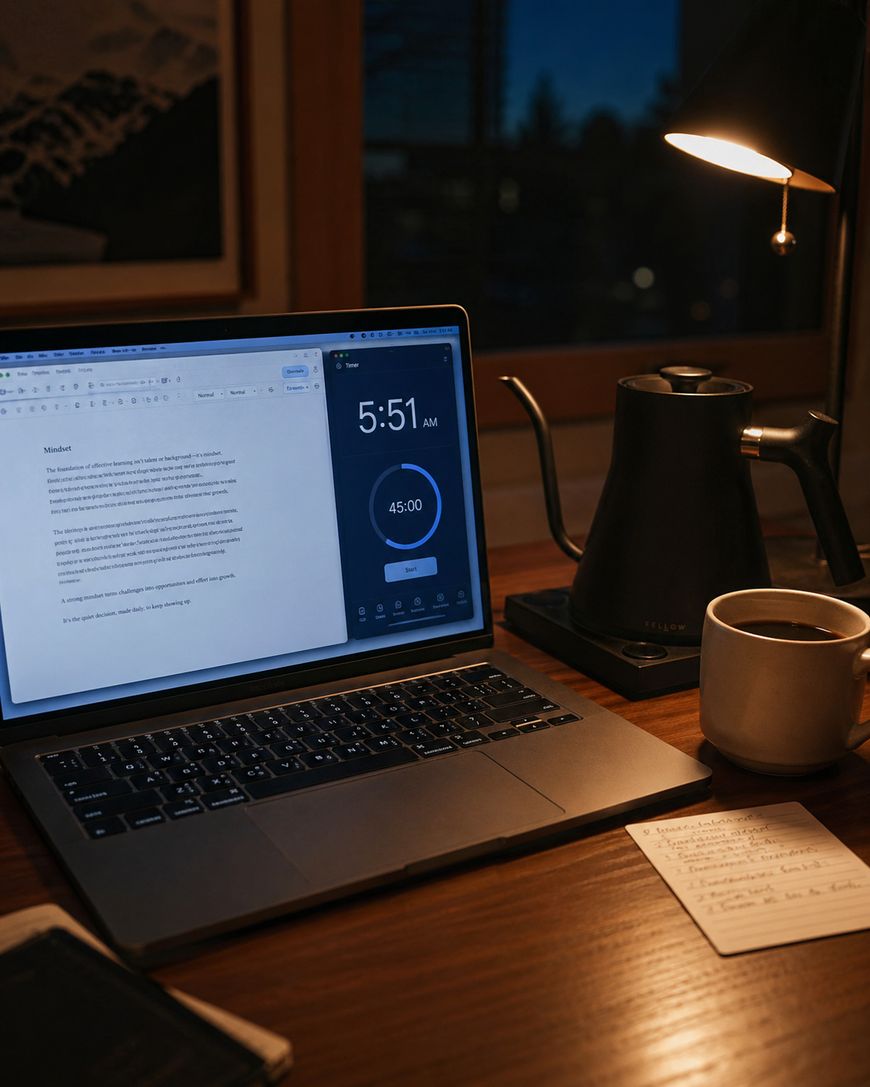
Having tomorrow’s core work block task identified the night before, written on a notecard or in a Leuchtturm1917 journal, is the difference between sitting down and immediately working versus spending 15 minutes deciding what to do. Preparation the night before is the secret ingredient of every successful 5am routine.
What to Include in a 5am Routine
The best 5am routine includes movement, mindfulness, and meaningful work in that order. Each component serves a distinct physiological or psychological function, and removing any one of them reduces the overall impact of the morning.
Movement
A 20 to 30-minute movement practice before sitting down to work is one of the most evidence-backed components of any 5am routine. Exercise increases BDNF (brain-derived neurotrophic factor), which neurologist and author Dr. John Ratey calls “Miracle-Gro for the brain,” improving focus, memory consolidation, and creative thinking for up to two hours afterward.

The form of movement matters less than consistency. A Peloton ride, a 30-minute strength session from the Jeff Nippard YouTube channel, a brisk outdoor walk, or a beginner yoga flow all produce the same cognitive benefits if performed at moderate-to-high intensity for at least 20 minutes.
Mindfulness or Journaling
A five to ten-minute mindfulness or journaling practice after movement is the component of a 5am routine that most people skip and most regret skipping. The Headspace or Calm app guided morning meditations are designed for exactly this window and produce measurable reductions in cortisol levels when practiced consistently for eight or more weeks.

Journaling using the three-questions method, writing what you are grateful for, what would make today great, and one affirmation, takes five minutes and builds what positive psychology researchers call “psychological capital,” the reservoir of optimism and resilience that determines how well people handle adversity.

Cold Exposure
A 30-second to 2-minute cold shower at the end of the morning routine has been popularized by Andrew Huberman of the Huberman Lab podcast and Wim Hof, and the research supports the practice for improving alertness, mood, and metabolic rate. The dopamine increase from cold exposure lasts three to four hours, which covers the entire productive morning window.
Start with 30 seconds of cold at the end of a warm shower rather than a full cold plunge. The goal is a brief, consistent dose of cold water exposure that signals alertness to the nervous system, not an endurance test.

5am Routine Sample Schedule
A practical 5am routine for a working professional, parent, or student covers movement, mindfulness, and meaningful work within a two-hour window that ends at 7 AM before most households wake up.
The Full Two-Hour Block
5:00 AM: Wake, drink 16 ounces of water with a pinch of pink Himalayan salt, open a window or step outside for two minutes of natural light exposure.
5:05 AM: Change into workout clothes and complete a 25-minute movement session, either a brisk walk, a Peloton ride, a resistance training session, or a yoga flow depending on the day’s plan.

5:30 AM: Five-minute journal entry using the three-questions method, followed by five minutes of guided meditation on Headspace or Calm.
5:40 AM: Brew coffee using a Chemex or a Fellow Stagg EKG kettle and make a simple breakfast, overnight oats prepared the night before, Greek yogurt with granola, or a protein shake.
5:50 AM: Sit at the desk, close all browser tabs, set a 60-minute Pomodoro timer, and begin the core work block on the single most important task identified the night before.
6:50 AM: Review what was completed, write tomorrow’s core task on a notecard, and transition to the family or household morning.
5am Routine Mistakes to Avoid
Most 5am routines fail within the first month for predictable and avoidable reasons. Understanding these failure modes before starting is the most reliable way to build a morning practice that lasts.
Checking the Phone First
Checking email, Instagram, or news within the first 30 minutes of waking is the single most common reason that 5am routines lose their effectiveness. Reactive content consumption puts the brain into a distracted, reactive state that takes up to 90 minutes to recover from, effectively eliminating the cognitive advantage of waking early.
Keep the phone in another room on airplane mode and use a dedicated alarm clock, the Hatch Restore 2 or a classic analog alarm, so that waking does not require touching the phone.
Inconsistent Bedtime
A 5am wake time without a consistent 9 to 9:30 PM bedtime produces chronic sleep deprivation within one to two weeks. Sleep deprivation reduces prefrontal cortex function, impairs decision-making, and makes the early morning feel miserable rather than productive.
Treat the bedtime as non-negotiable as the wake time. A wind-down routine beginning at 8:30 PM that includes dimming lights, reading fiction, and avoiding screens prepares the nervous system for sleep in a way that leads to falling asleep faster and sleeping more deeply.
5am Routine Questions
How long does it take to adjust to waking at 5am? Most people fully adjust to a 5am wake time within three to four weeks when the shift is made gradually by moving the alarm back 15 minutes every three to five days. Attempting the shift overnight typically results in exhaustion and abandonment within the first two weeks.

What should you eat before a 5am workout? A small pre-workout snack of 100 to 200 calories is ideal for a 5am workout, and the best options are a banana with a tablespoon of almond butter, a small container of Greek yogurt, or half a protein bar. Training fully fasted is also effective for fat-burning goals but is not necessary for cognitive benefits.
Is a 5am routine worth it for night owls? A 5am routine can be effective for chronotypically late people if the sleep schedule is shifted consistently to allow seven to eight hours, but forcing a 5 AM wake time without adjusting the bedtime creates a sleep debt that eliminates all cognitive benefits. Protecting a quiet two-hour morning block at 6 AM or 7 AM produces equivalent results for night owls who cannot sustain earlier wake times.
Can a 5am routine work with young children? Yes, a modified 5am routine works with young children by focusing the core work block on the single highest-value task rather than attempting a full two-hour flow. Even 45 focused minutes before children wake is enough to make meaningful progress on a creative or professional goal when the practice is maintained consistently.
Start Your 5am Routine Tomorrow Morning
The best 5am routine is the one you actually show up for consistently, and the most important decision is not what to include but when to start. Set the alarm 15 minutes earlier than usual tomorrow morning, drink a glass of water before reaching for the phone, and spend those extra minutes on the one thing that matters most to you.
A sustainable 5am routine is built one 15-minute increment at a time over four weeks, not transformed overnight. The mornings you protect now are the ones that determine what you build over the next year.