Last updated: October 6, 2026
Christmas butter cookies take seven simple ingredients and one chilled dough, and this version bakes up tender, buttery, and sharp-edged every time.
Roll, cut, and bake them with the full recipe card below, or keep reading for every tip that helps them turn out right.

What You Need for Christmas Butter Cookies
The dough uses butter, sugar, one egg, flour, salt, and two extracts, which means you probably have everything in your kitchen already.

Because there are so few ingredients, the quality and temperature of each one shows up in the finished cookie.
The Full Ingredient List
You need 1 cup (226 grams) of unsalted butter, softened, and 3/4 cup (150 grams) of granulated sugar.
Add 1 large egg at room temperature, 2 teaspoons of pure vanilla extract, and 1/4 teaspoon of almond extract.
The dry ingredients are 3 cups (375 grams) of all-purpose flour, plus extra for rolling, and 1/2 teaspoon of fine salt.
For a festive finish, you can also use 2 tablespoons of red and green sanding sugar, which is optional.
Why Softened Butter Matters
Softened butter should give slightly when you press it but still hold its shape, without looking shiny or greasy.
Butter that is too warm makes a sticky dough that spreads in the oven and loses its sharp edges.
If your kitchen is warm, cut the butter into cubes and let it sit for about 20 minutes instead of leaving whole sticks out for an hour.
Measuring the Flour
Too much flour is the most common reason butter cookies turn out dry and crumbly.
Spoon the flour into your measuring cup and level it with a knife, or weigh it on a kitchen scale for exactly 375 grams.
Dough that feels slightly soft right after mixing is correct, because chilling firms it up for rolling.
Why a Little Almond Extract Helps
Just 1/4 teaspoon of almond extract gives the cookies the bakery flavor people associate with Danish-style butter cookies.
It works as a background note rather than a headline flavor, and you can simply leave it out and keep the 2 teaspoons of vanilla.
How to Make the Dough
The dough comes together in one bowl with an electric mixer, and it takes about 25 minutes from the first beat to the refrigerator.
Work in four simple stages: cream the butter and sugar, add the egg, mix in the flour, and chill.
Cream the Butter and Sugar
Beat the butter and granulated sugar on medium speed for about 2 minutes, until the mixture looks pale and fluffy.

Stop at 2 minutes, because beating in too much air makes butter cookies puff up and then settle, which softens the shapes.
Add the Egg and Extracts
Beat in the egg, vanilla extract, and almond extract until smooth, scraping down the sides of the bowl once.
The mixture may look slightly curdled for a moment, and it smooths out as soon as the flour goes in.
Mix In the Flour
Whisk the flour and salt together in a separate bowl, then add it to the butter mixture in two additions on low speed.

Stop mixing as soon as the dough just comes together with no dry streaks, since overmixing develops gluten and makes the cookies tough.
Chill the Dough
Divide the dough in half, flatten each half into a disc about 1 inch thick, and wrap each one tightly in plastic wrap.
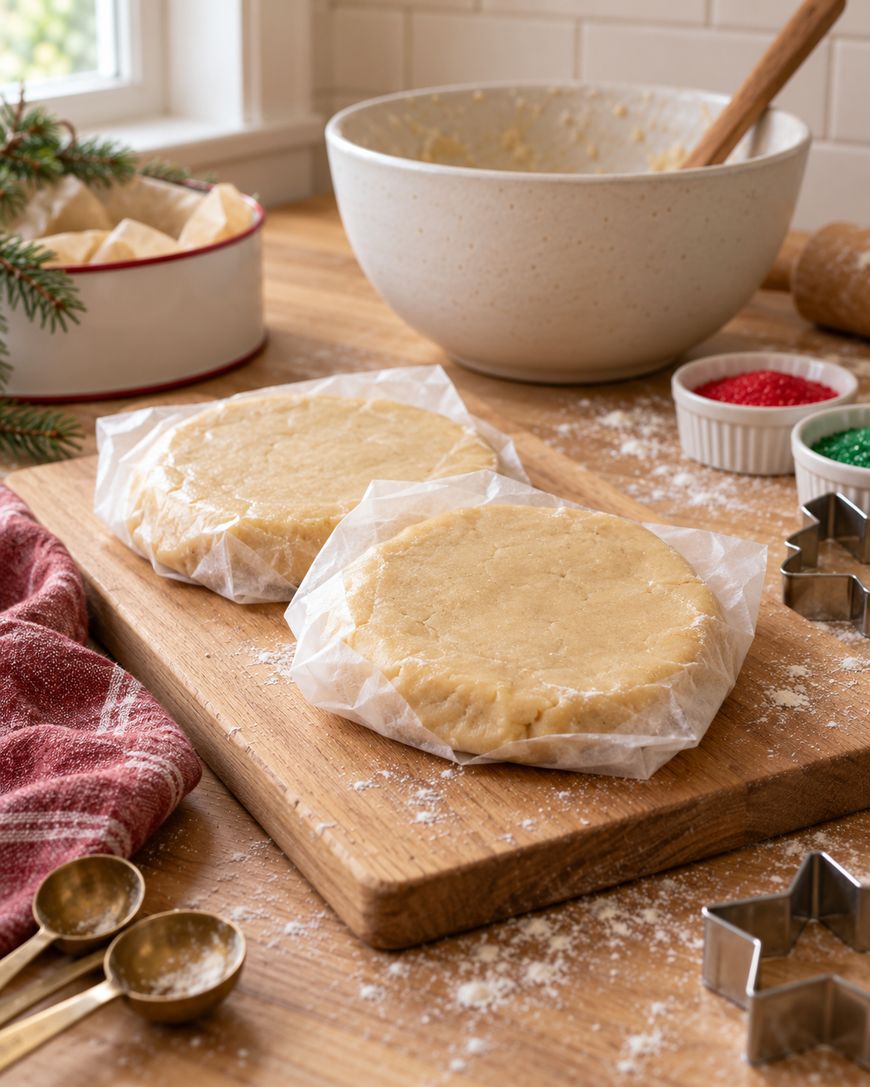
Refrigerate the discs for 1 hour, until they are firm enough to roll without sticking.
How to Roll, Cut, and Bake Christmas Butter Cookies
Rolling and baking is where butter cookies either hold their shape or spread, so the order of these steps matters.
Heat the oven to 350°F and line two baking sheets with parchment paper before you roll anything.
Roll the Dough to an Even Thickness
Roll one disc on a lightly floured surface until it is 1/4 inch thick, turning the dough a quarter turn every few passes.

Even thickness matters because thin spots brown before thicker ones finish, and the second disc stays in the refrigerator until you need it.
Cut the Shapes and Re-Roll the Scraps
Cut shapes with 2 1/2 inch cutters such as stars, trees, wreaths, and bells, and place them 1 inch apart on a baking sheet.

Gather the scraps once, press them together, and re-roll them one time only, because a third roll makes the dough tough.
Repeat with the second disc on the second baking sheet, so each sheet holds about 15 cookies.
Chill the Cut Cookies
Slide both baking sheets into the refrigerator for 15 minutes before baking.

This quick second chill firms the butter so the edges stay crisp and the shapes stay put.
If you are using sanding sugar, sprinkle it over the chilled cookies right before they go into the oven.
Bake Until the Edges Turn Pale Golden
Bake both sheets at once for 10 to 12 minutes, swapping the racks and rotating the sheets halfway through.
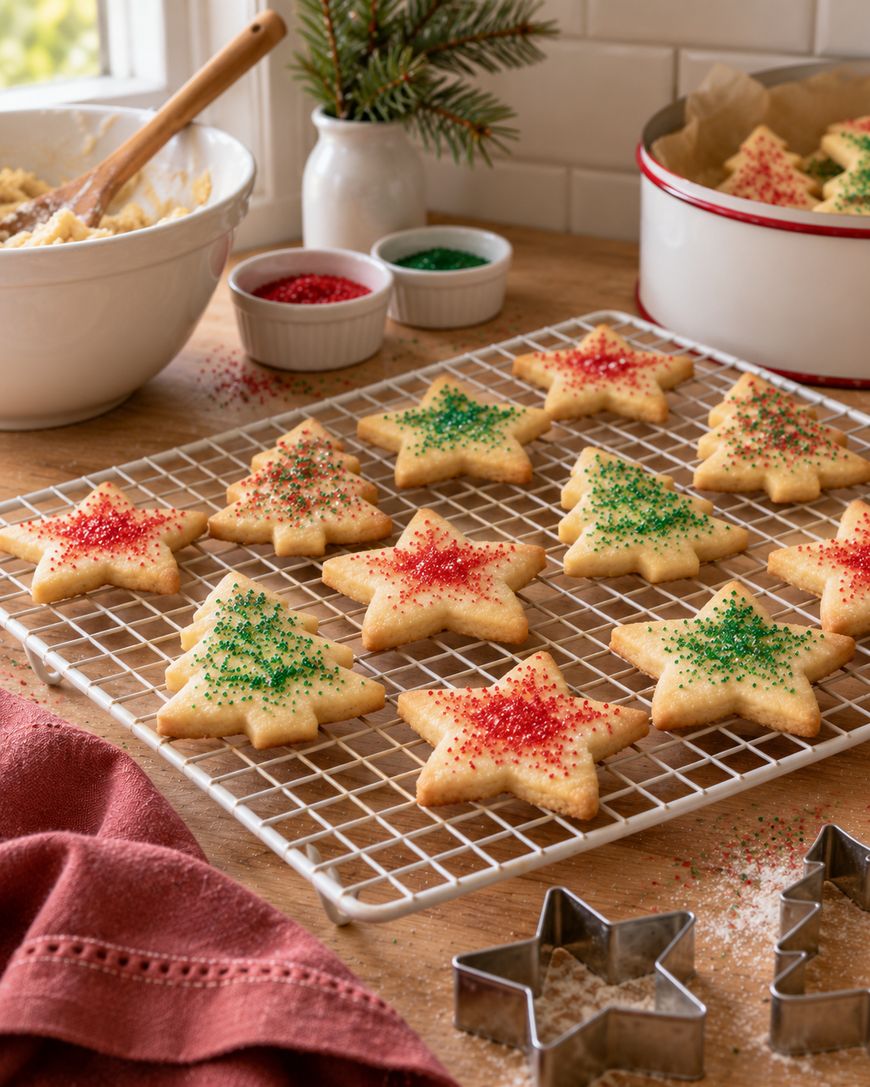
The cookies are done when the edges just turn pale golden while the centers still look soft, because they finish setting as they cool.
Cool them on the sheets for 5 minutes, then move them to a wire rack to cool completely.

Decorating and Variations for Christmas Butter Cookies
Plain butter cookies are delicious, and a few simple finishes make them look like they came from a holiday cookie tin.

Each of these changes keeps the base dough exactly as written in the recipe card.
Sanding Sugar
Red and green sanding sugar gives the cookies a sparkle that survives baking, since the crystals are larger than regular sugar and do not melt.

Sprinkle it over the chilled cutouts right before baking, and use about 2 tablespoons for the whole batch.
A Simple Icing
For an iced version, stir 1 cup of powdered sugar with 2 tablespoons of milk until smooth, then spread it over completely cooled cookies.
The recipe card leaves the icing out, so treat it as an optional extra and let it set for about an hour before stacking.
Lemon Zest
Adding 1 teaspoon of finely grated lemon zest with the egg gives the cookies a bright, fresh note that pairs well with a cup of tea.
The recipe card leaves this out, so treat it as an optional variation.
Using Salted Butter
If you only have salted butter, use it and reduce the fine salt to 1/4 teaspoon.
The cookies will still taste balanced, though unsalted butter gives you more control over the final flavor.
A Short History of Butter Cookies
Butter cookies belong to a long European tradition of Christmas baking, especially in Denmark, Germany, and Sweden, where a simple dough of butter, sugar, and flour is cut, stamped, or piped into festive shapes.
Many families still bake a batch every December and pack them into tins to share with neighbors and friends.
The appeal is easy to understand, since the dough relies on butter for nearly all of its flavor and needs no complicated technique.
Our version keeps that spirit while using a cut-out dough that works with any cookie cutter you already own.
Swap in your favorite shapes, and the same recipe works for stars, trees, wreaths, mittens, and gingerbread people alike.
Because the dough is not overly sweet, it also makes a sturdy base for cookie exchanges, gift boxes, and tins that need to travel.
Bake a double batch and you will have plenty to share without much extra effort.
Ready to bake? Use the recipe card below for the exact measurements, times, and nutrition details.

Christmas Butter Cookies
Tender, buttery cut-out cookies rolled 1/4 inch thick and chilled twice so they hold their shape, finished with red and green sanding sugar for the holidays.
Ingredients
- 1 cup (226 g) unsalted butter, softened
- 3/4 cup (150 g) granulated sugar
- 1 large egg, at room temperature
- 2 teaspoons pure vanilla extract
- 1/4 teaspoon almond extract
- 3 cups (375 g) all-purpose flour, plus more for rolling
- 1/2 teaspoon fine salt
- 2 tablespoons red and green sanding sugar, optional
Instructions
- Beat the butter and granulated sugar in a large bowl with an electric mixer on medium speed for about 2 minutes, until pale and fluffy.
- Beat in the egg, vanilla extract, and almond extract until smooth, scraping down the bowl once.
- Whisk the flour and salt together, then add to the butter mixture in two additions on low speed, mixing just until the dough comes together with no dry streaks.
- Divide the dough in half, flatten each half into a disc about 1 inch thick, wrap tightly in plastic wrap, and refrigerate for 1 hour.
- Heat the oven to 350°F and line two baking sheets with parchment paper.
- Roll one disc on a lightly floured surface to 1/4 inch thick, cut shapes with 2 1/2 inch cutters, and place them 1 inch apart on one baking sheet. Re-roll the scraps once, then repeat with the second disc on the second baking sheet.
- Refrigerate both baking sheets for 15 minutes, then sprinkle the cookies with sanding sugar if using.
- Bake both sheets for 10 to 12 minutes, swapping the racks and rotating the sheets halfway through, until the edges are pale golden.
- Cool on the baking sheets for 5 minutes, then transfer to a wire rack to cool completely.
Notes
Wrapped dough discs keep in the refrigerator for up to 3 days or in the freezer for up to 2 months; thaw frozen dough overnight in the refrigerator. Store baked cookies in an airtight container at room temperature for up to 5 days or freeze for up to 3 months. If using salted butter, reduce the fine salt to 1/4 teaspoon. Do not eat the raw dough because it contains raw flour and raw egg.
Nutrition Information:
Yield:
30Serving Size:
1 cookieAmount Per Serving: Calories: 120Total Fat: 6gSaturated Fat: 4gSodium: 41mgCarbohydrates: 14gFiber: 0gSugar: 5gProtein: 1g
Christmas Butter Cookies FAQ
Why did my Christmas butter cookies spread?
Spreading almost always comes from dough that was too warm when it hit the oven. Make sure the butter is only softened, chill the discs for the full hour, and chill the cut cookies for 15 minutes before baking. Always bake on cool parchment-lined sheets rather than warm ones.
Can you make the dough ahead of time?
Yes, the wrapped dough discs keep in the refrigerator for up to 3 days. You can also freeze the discs for up to 2 months and thaw them overnight in the refrigerator before rolling.
How long do the cookies stay fresh?
Store baked cookies in an airtight container at room temperature for up to 5 days. You can also freeze them for up to 3 months and let them thaw on the counter.
Can you use salted butter?
Yes, just reduce the fine salt in the dough to 1/4 teaspoon. Unsalted butter is still the better choice because it lets you control the salt.
Is it safe to taste the raw dough?
The FDA advises against eating raw dough because raw flour and raw eggs can carry harmful bacteria. Bake the cookies fully before tasting, and wash your hands, bowl, and tools after handling the dough.
Why This Christmas Butter Cookie Recipe Works
The butter-to-flour ratio is built for rolling, with 1 cup of butter to 3 cups of flour. That balance gives you a dough that tastes rich but stays sturdy enough to cut cleanly.
Creaming the butter and sugar for only 2 minutes keeps the dough dense, and the recipe uses no baking powder or baking soda. With so little lift, the cutouts bake flat and the edges stay sharp.
Two rounds of chilling do the rest of the work, one hour for the dough and 15 minutes for the cut cookies. Cold butter melts slowly in the oven, which gives the dough time to set before it can spread.
One whole egg binds the dough without making it cakey, and a small amount of almond extract adds that classic bakery flavor. Together they keep the cookies tender in the middle while the edges bake crisp.
The result is a cookie that cuts cleanly, bakes evenly, and tastes like real butter from the first bite to the last crumb.
Bake Your Christmas Butter Cookies This Weekend
Christmas butter cookies are one of the easiest holiday bakes, and they reward a little patience with tender centers and crisp edges.
Mix the dough tonight, chill it overnight if you like, and bake a batch this weekend with the recipe card above.