Last updated: October 8, 2026
Radiant and emerald-cut engagement rings can look surprisingly similar until you see them move. Both can have straight sides and clipped corners, but the pattern of light inside the diamond is quite different.
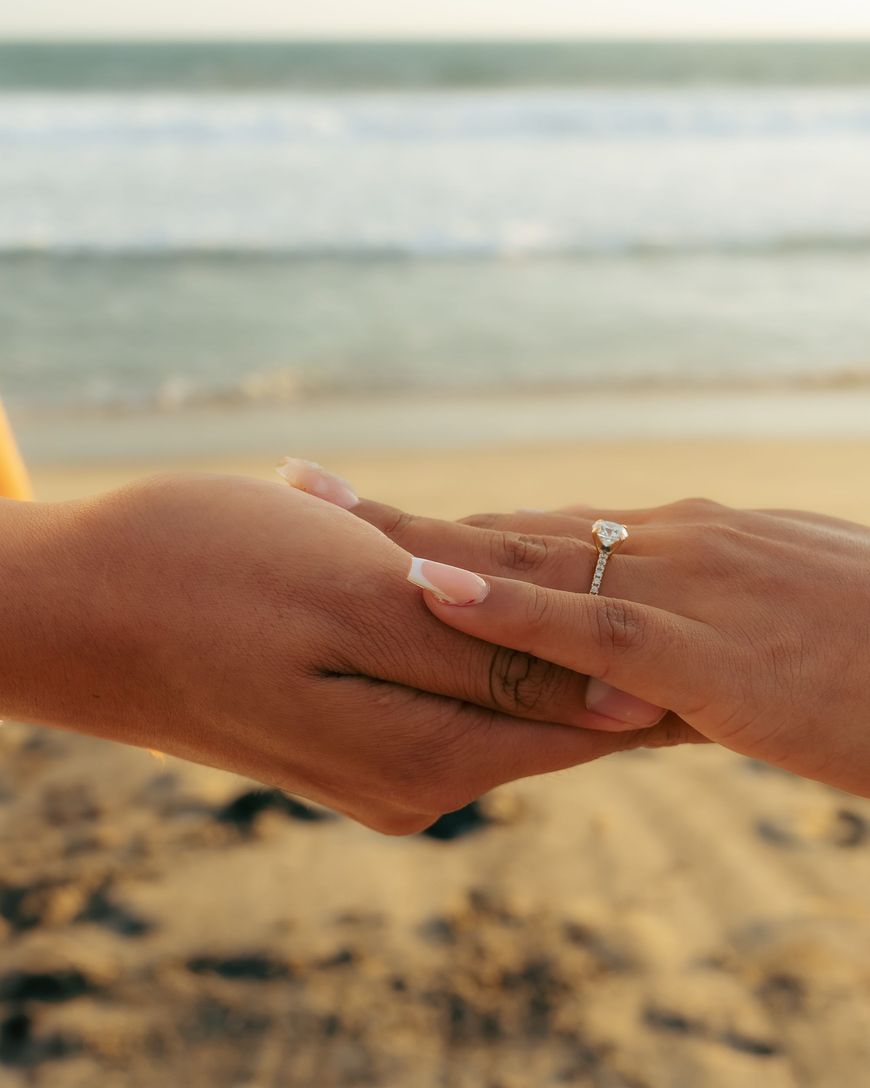
A radiant has a lively, intricate sparkle. An emerald cut gives broader flashes and a more clearly visible pattern of steps. If you love a rectangular ring but keep changing your mind between the two, start with that difference rather than the carat weight.
Radiant vs emerald cut: what changes the sparkle?
The small polished surfaces on a diamond are called facets. In an emerald cut, long facets run in steps, producing a mirror-like effect. A radiant combines its angular outline with brilliant-style faceting, creating smaller flashes as it moves.
GIA’s guide to diamond shapes describes these different effects. An emerald cut’s quieter sparkle is part of its character, rather than a reason to dismiss it as a poorer diamond.
Keep the surrounding design simple while deciding which effect you enjoy. Lily Arkwright’s radiant cut engagement rings include the Lulu solitaire, also available with an emerald-cut centre. Both platinum lab-grown diamond versions have a 1.65mm band. Compare stones with similar length and width measurements, too: the same setting can hold different-sized stones.
Watch both stones move slowly in the same lighting, then look at them still. Try ordinary daylight as well as indoor light. A dramatic flash in one video frame tells you less than seeing how the whole pattern changes.
| Feature | Radiant cut | Emerald cut |
|---|---|---|
| Faceting | Brilliant-style facets | Long facets arranged in steps |
| Light pattern | Smaller, closely packed flashes | Broader, mirror-like reflections |
| Inclusion visibility | Some inclusions may be less noticeable | Open facets can reveal inclusions more readily |
Which cut looks bigger on your hand?
Neither name guarantees a larger-looking stone. Radiants can be square or rectangular, and elongated diamonds can vary considerably in their proportions. A long, narrow stone gives a different impression from a broader one.
Use the length and width in millimetres to compare the space each stone occupies. As GIA explains, carat weight is not the same as visible size: some weight sits in the depth of the diamond.
Compare straight-down photographs shown at a similar scale, rather than two product images enlarged to fill their frames. Check the carat weight used in each photograph, too. The Lulu model-hand images currently show a 3ct radiant and a 1.50ct emerald-cut diamond, so they are not a like-for-like size comparison.
For a styling decision, similar visible dimensions make the sparkle comparison easier. For a budget decision, compare the actual stones you could buy within your spending limit.
Why colour and clarity deserve a closer look
The emerald cut’s open-looking centre can make inclusions, the features within a diamond, easier to notice. A radiant’s faceting can make some inclusions less noticeable. That does not mean every emerald cut has obvious marks or that every radiant hides them.
Ask to see the specific diamond rather than relying entirely on sample photography. Look at it without magnification as well as in any close-up images, and ask the jeweller to explain the features recorded on its grading report.
The highest clarity grade is not an automatic requirement. Find out what is visible in the particular stone, where it appears and whether it distracts you. A grading label cannot replace looking at the diamond.
Step cuts can also show a diamond’s body colour more readily. If you want a colourless appearance, compare any visible warmth in the actual stones under the same lighting, rather than assuming one minimum colour grade will suit everyone.
Let the setting support the effect you like
A plain solitaire makes the centre stone’s outline easy to appreciate. Diamond-set shoulders add sparkle along the band, while a halo frames the stone with another line of light.
An emerald-cut centre with small brilliant-cut diamonds around it can combine broad reflections with finer sparkle. A radiant on a plain band keeps the attention on the sparkle within the stone. Both cuts work in simple or more decorative designs.
Try your favourite alongside the rings and watch you already wear. See whether you enjoy the combination, without letting labels such as “classic” for emerald cuts or “modern” for radiants decide for you.
Compare the complete rings before deciding
If one quote is lower, find out what differs. Compare the centre stones’ natural or laboratory-grown origin, weight, dimensions, colour and clarity, along with the metal and any smaller diamonds. Do not assume the price difference comes from the cut alone.
Once you have two realistic options, try each ring for a few minutes. Look away from the close-up and then glance back as you normally would during the day. You may find that the broad flashes you overlooked in a photograph are what you enjoy most, or that the radiant’s lively sparkle is exactly what you were hoping for.